Jane Jacobs, Greenwich Village, and the Life of the City
No one has had a bigger influence on how we think and talk about New York City than the writer and activist Jane Jacobs. The ideas and often the very language that we use to express what we love about New York and what we want for the city come from Jacobs, sometimes without us even realizing it. Her beliefs—that urban development should be gradual, that the city should exist at a scale appropriate to the human body, that ordinary people possess all the tools necessary to understand and act on the urban environment—form the common sense (another important Jacobsian term) of contemporary urban thinking to a degree no other thinker can match.
This raises the question—where did Jacobs’s ideas come from? In this tour, we will embark on a collective investigation of Jacobs’s theories using her favorite method—walking. In traversing Greenwich Village, Jacobs’s adopted home and the seedbed of her way of looking at the city, we will uncover the roots of ideas like “mixed-use,” “sidewalk ballet,” and “eyes on the street” by linking them to the physical and social environment of the Village itself.
This means asking a series of questions. What makes the West Village unique, both physically and socially? How did this distinctiveness shape Jacobs’s beliefs about cities? Should the nineteenth-century streetscape that so enchanted Jacobs be preserved, even if it means turning the Village into an exclusive precinct? What happened to the Village, and to Jacobs’s ideas, with the epochal shifts in economy, society, and politics that transformed New York in the 1970s and beyond? Given these changes, and the far different city we confront today, can Jacobs's ideas be adopted, or adapted, to create the kind of city she wanted for anything like a majority of the people living here?
Further reading: Andy’s essay on Jane Jacobs at the New York Review of Architecture.
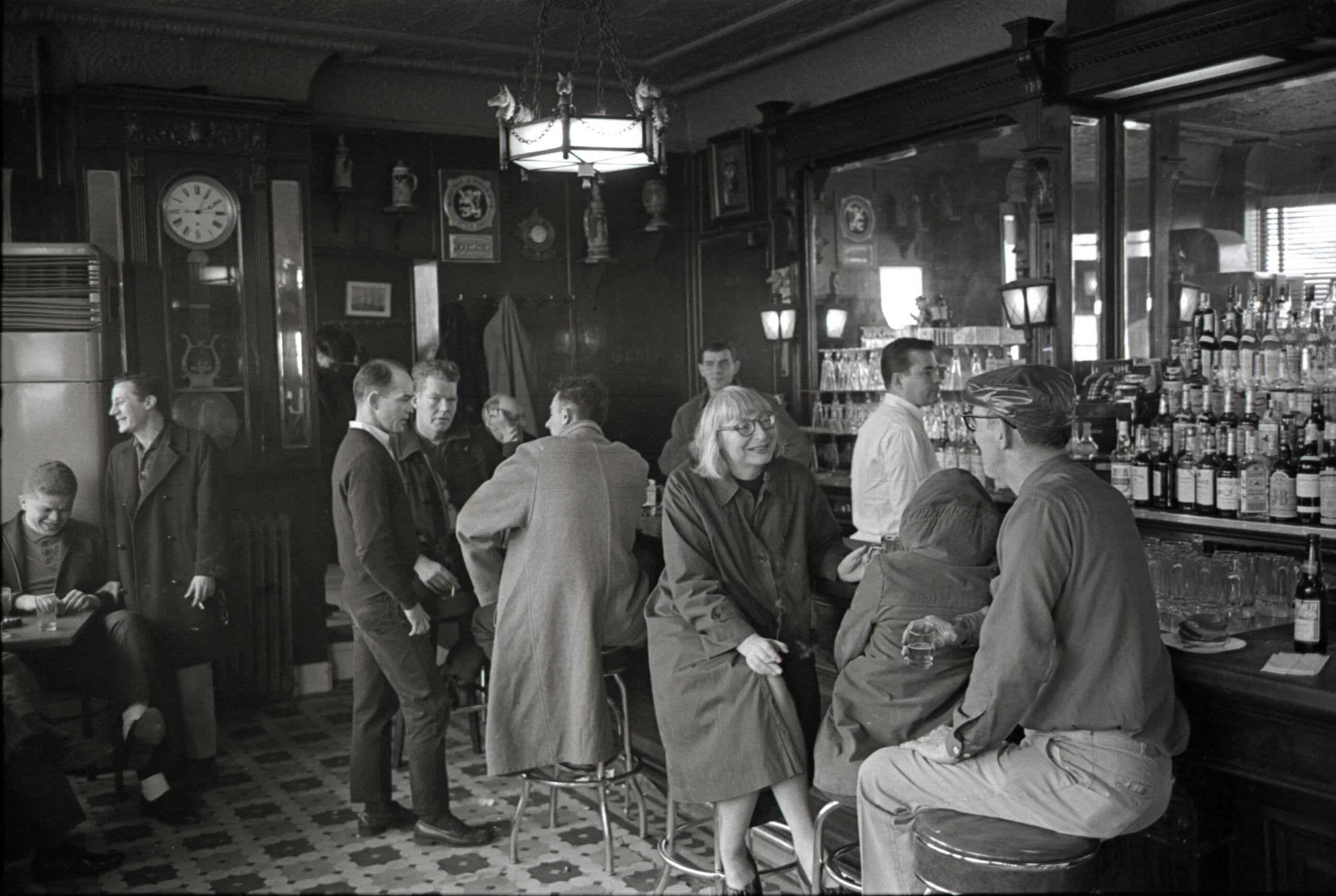
The spontaneous encounter and the human scale: Jane Jacobs shares a drink and a chat at the White Horse Tavern, which formed part of the scene for her famous vignette about the “sidewalk ballet” in which all good urbanites engage.